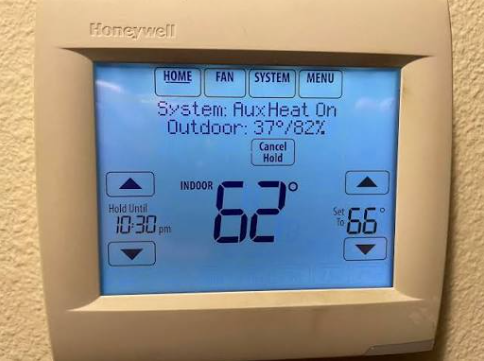
The thermostat reads EMERGENCY HEAT at six in the morning, and it read the same thing yesterday, and the morning before that. By the fourth day most homeowners stop staring at the display and start pricing hvac repairs covington ga. The house sits at sixty six degrees no matter where the dial goes. Four straight mornings on backup heat is not weather. It means the outdoor unit has quit doing the part of the job that saves money, and the January power bill is only the receipt.
Backup Heat Is A Failover That Never Fails Back
Auxiliary heat, what the trade calls strip heat, is a bank of electric resistance coils sitting in the air handler. It exists to cover the gap when the outdoor unit cannot pull enough warmth out of cold air, or when it is parked in a defrost cycle and the fan is blowing room temperature air. Think of it the way an operations team thinks about a standby node. Nobody minds it carrying traffic for twenty minutes during an incident. Everybody minds when it has been carrying traffic since Tuesday and nothing ever failed back to the primary.
That is the failure mode worth naming, because a heat pump stuck on auxiliary keeps the house habitable and nothing looks broken from the hallway. The meter does not lie, though, and by the time the bill arrives the system has usually been running in failover for two or three weeks. On an eleven year old three ton unit serving about 1,900 square feet, what usually turns up is a defrost board that stopped sequencing, a reversing valve that will not shift, or a refrigerant charge low enough that the outdoor coil ices over in the morning and stays iced all day.
See also: Reasons Fundraising Relies on VDRs for Secure Document Sharing and Access
What The Two Weeks After The Call Look Like
Day one is measurement, not parts. A technician puts gauges on the system, reads suction and liquid pressures against the outdoor temperature, watches whether the unit enters and exits a defrost cycle on command, and checks whether the strip heat is being energized by a failed sensor instead of by real demand. Most of that lands inside the first hour. If the culprit is a control board or a defrost sensor, the repair often closes on that same visit.
Within the first week the auxiliary indicator should go dark on mild mornings, which is the cleanest confirmation available that the fix took. By the second week the daily kilowatt hours tell the rest of the story. Say that 1,900 square foot house was pulling roughly 60 kWh a day through a mid January stretch below thirty degrees. Honestly, call it closer to 70 on the coldest three days, since the strip heat and the blower both run harder than anyone budgets for. Back on compressor heat at Georgia residential rates, a plausible scenario puts that same house near 35 kWh a day, which is where the next statement starts looking normal again. After 14 days, with one more cold snap on the record, there is enough data to say the repair held.
Read The Thermostat, Not Only The Bill
A power bill is a lagging indicator that shows up three weeks after the money was spent. The thermostat is live, and watching that auxiliary indicator for a week costs nothing. An August 2026 rundown from HVAC Base put auxiliary electric resistance heat at a coefficient of performance of 1.0 against 2.5 to 3.5 for the heat pump itself, which is roughly a third of the heat per dollar spent.
Anyone typing hvac repairs covington ga into a phone before sunrise is really asking one question: is this the weather, or is this the equipment? Four consecutive mornings on backup, in a house that will not clear sixty six degrees, answers it well enough to pick up the phone. Get the outdoor unit read by someone with gauges before the next cold stretch arrives, because strip heat will carry a house through to spring at roughly three times the cost of the system you already own.