Tile cracks. Tile slips. Tile takes a boot two inches off the batten, splits down the middle, and then sits there looking terrible for eight years without letting one drop into the house. That distance between damage you can see and damage that actually matters is what tile roofers venice fl spend half their estimating time explaining to worried owners. The argument here fits in a line: a cracked barrel tile is cosmetic until the underlayment beneath it fails, so the question is never how many tiles broke, it is what the membrane under them has left.
Tile Sheds Water But Underlayment Stops It
A barrel tile roof is two systems stacked on each other. The tile is a shell that takes the sun, throws off the bulk of the rain, and keeps ultraviolet light away from what sits below. The waterproofing is the underlayment, the felt or synthetic membrane fastened to the deck under all that clay or concrete. Rain driven sideways by a Gulf thunderstorm gets under tile constantly, by design, and the underlayment is what carries it back down to the drip edge. Break a tile and you have opened a small window of that membrane to direct sun and direct water. On a 2004 roof still wearing its original felt, that window is the thing worth worrying about, not the ceramic. What we find on most of these inspections is an owner braced for a tile bill who needs an underlayment answer instead.
See also: How to Choose the Right Cube Sauna Size for Your Space for Beginners
Counting Cracked Tile From The Ground
Thirty-two broken tiles sounds like a catastrophe. Counted with binoculars from the driveway, it usually is not. Do the count yourself and note where the breakage clusters, because a cluster tells a story a raw number never will: a line of cracks running across the middle of a slope is a walking path, which means a solar crew or a pressure washing crew took the short route instead of the supported one. Tile is walked only where it is supported, and only by people trained and equipped for fall protection. Nobody else belongs up there, a rule federal investigators underlined with $172,324 in proposed penalties against a roofing employer whose crew worked more than 20 feet up with no personal fall protection after two men slid off a two-story house, one of them fatally. The common version of this going wrong is duller and just as bad: a ladder footed on wet grass or uneven ground that kicks out while somebody is three rungs from the top.
Spot Repair Compared With Relifting A Section
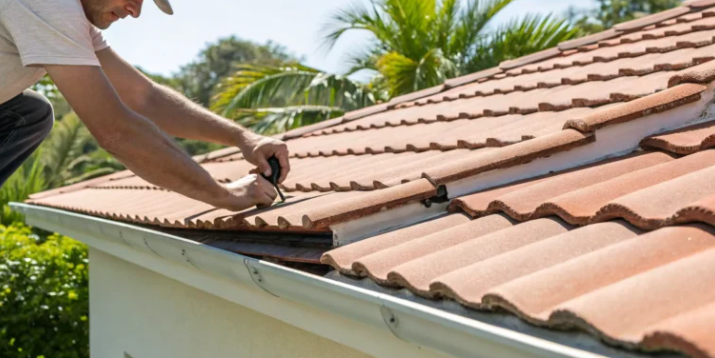
Three options, and the underlayment sets their order. Swapping tiles is cheapest, since a crew matches profile and color, sets replacements on the existing battens or mortar, and leaves the membrane untouched. That is the right call when the felt under the break still has flex in it. Relifting sits in the middle: tile on the affected slope comes off by hand and gets stacked, fresh underlayment goes down over the deck, and the same tile goes back on, which works because clay and concrete barrel tile outlives the membrane below it by decades. Full replacement is the honest answer once the underlayment is original and past twenty years, because relifting one slope in year twenty-two means paying again for the next slope in year twenty-four.
The tile roofers Venice FL owners call for a second opinion tend to start in the same place, lifting one field tile near a valley and one at the eave to see how the membrane behaves when it is bent. Brittle felt that cracks at the fold has told you everything. I will admit a bias while I am here, because the mortar-set ridge work on these older roofs is genuinely beautiful and I would rather rebuild one than price anything. Back to the fold test, which is the cheapest information you will get all week.
What The Weeks After Repair Look Like
The first week after a tile repair is dusty and a little disappointing to look at. Replacement tile rarely matches on day one, since new clay reads brighter and salvaged tile from a supplier’s yard usually lands a shade off, and Gulf sun needs a season to pull them together. By week three you should be able to run a hose across the repaired slope and see nothing at all on the ceiling below. Within 90 days you will have taken at least one real storm, and that is the honest test, because wind-driven rain out of the southwest loads a roof in a way no garden hose can imitate.
Does a broken tile mean my roof is leaking?
Usually not, and that is exactly why the damage goes unaddressed for years. The tile is a shell and the felt underneath is still doing its job. The leak shows up later, once sun and rain have worked on the exposed membrane long enough to open it, and by then the repair is bigger.
Can I just have the broken tiles swapped and skip the rest?
On a younger roof, yes, and it is a fine use of money. On a roof running its original underlayment past two decades, a tile swap buys appearance and almost nothing else. Ask the estimator to price the swap and the relift side by side so you can see what the difference actually costs.
Underlayment Age Decides The Whole Question
Everything above collapses into one number, and it is not thirty-two. It is the year the membrane went down. A 2004 roof on original felt is twenty-two years into a climate that runs hot, wet and salty, and that underlayment has been running on borrowed time for a while now. If nobody remembers the year, the Sarasota County Property Appraiser’s parcel search is free and will at least hand you the year the structure was built. A June 2026 hurricane season roundup published by the Florida roofing firm NEXGEN Roofing put code-compliant construction at up to 72% lower windstorm losses than older work with no proper wind mitigation, which is a fair reminder that a re-roof buys current fastening and a current secondary water barrier, not simply new felt. So price all three routes, ask for photographs of the membrane rather than the tile, and let the answer follow what those photographs show.